

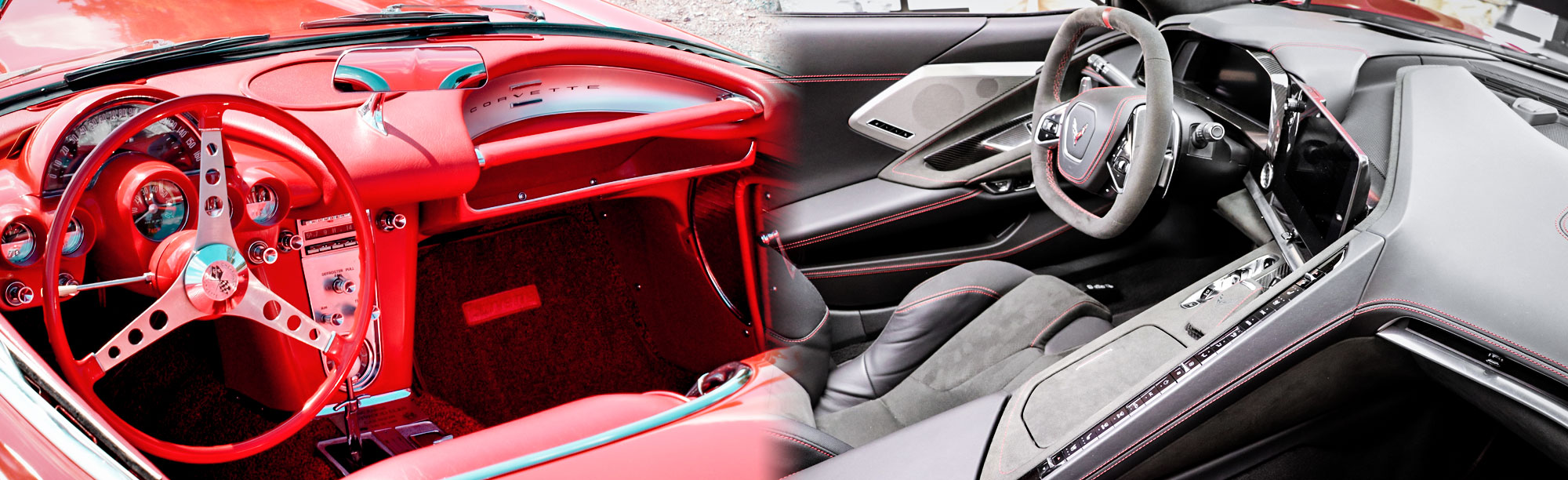
Every Corvette generation has told a different design story through its dashboard, and looking at how it’s evolved says a lot about how the car itself has changed, from a utilitarian sports car to a genuine grand tourer to today’s digitally native performance machine. Here’s a generation-by-generation look, along with the restoration issues each generation’s dash tends to bring.
C1 (1953–1962)
The original Corvette’s dash was straightforward by today’s standards, with gauges centered on the dash rather than ahead of the driver, making them harder to read at a glance while driving. The large steering wheel included a distinctive inner “half wheel,” part of the era’s more utilitarian approach to cabin design that prioritized simplicity over the driver-focused ergonomics later generations would adopt. Restoring a C1 dash today often means sourcing increasingly scarce original gauge faces, since reproduction quality varies significantly between suppliers.
C2 (1963–1967)
The Sting Ray era brought independent rear suspension along with a more driver-focused cockpit, improved gauge placement, and a cleaner instrument layout than the C1. While the overall design remained traditional, it established many of the ergonomic principles that continued into later Corvette generations. The C2’s dash is generally more durable than the C3’s that followed, though original woodgrain and trim pieces are increasingly hard to find in good condition.
C3 (1968–1982)
Over roughly 15 years of production, the C3 dash went through more variation than any other generation, tracking changing color and material trends of the era from bold late-60s hues to the more subdued palette of the late 1970s. It’s also the generation where owners today most often deal with cracking or fading dash pads, a common restoration point driven by decades of UV exposure on a dash design that sits more exposed to direct sunlight than later, more recessed designs. Full dash pad replacement is one of the more frequently requested C3 interior parts for exactly this reason.
C4 (1984–1996)
The C4 introduced a fully digital instrument cluster, advanced for its time, especially on 1984–1986 models with LCD-based displays and integrated warning indicators. It’s a distinctive design leap from the analog gauges of every prior generation, though aging electronics on original clusters are a common issue owners deal with today, since the LCD technology of that era degrades in ways modern displays don’t, often showing dim or partially failed segments after decades of use.
C5 (1997–2004)
The C5 marked a major step up in refinement: faster, lighter, stiffer, and quieter than the Corvettes before it. The cockpit grew roomier and was designed with comfort in mind alongside performance, reflecting the C5’s broader shift toward a more grand-touring feel without abandoning the analog gauge cluster that returned after the C4’s digital experiment, a decision that reflected mixed owner feedback on the C4’s digital displays.
C6 (2005–2013)
The C6, including the high-output Z06 variant with its 505-horsepower small-block, carried an aluminum and faux-metal “high tech” dash aesthetic that matched the car’s more aggressive overall styling direction. The Z06 badge in the speedometer was one of the few unique cabin touches distinguishing it from the standard C6, alongside more supportive seating and a simplified interior focused on weight savings.
C7 (2014–2019): The Modern Cockpit Emerges
The C7 introduced a more driver-focused cockpit layout with a configurable digital gauge cluster option, a meaningful step toward the fully digital displays that would follow. This generation also introduced more advanced infotainment integration than any Corvette before it, setting the stage for the C8’s even more digitally native approach.
C8: The Move to Fully Digital Cockpits
The C8 culminated this shift with a fully digital instrument cluster and a centered infotainment screen angled toward the driver, alongside the now-famous “wall of buttons” running down the center console. The most recent C8 update goes further still, replacing that wall of buttons between driver and passenger with a cleaner dash featuring a larger center touchscreen and an additional secondary display, a response to years of feedback about the original button wall dividing the cabin.
What This Means for Restoration and Repair
Dash-related issues track fairly predictably by generation: cracking and UV damage dominate on C1 through C3 dashes, electronic cluster failures are the primary concern on C4 through C6, and infotainment or software-related issues are more common on C7 and C8 dashes than any purely mechanical failure. Knowing which category your Corvette falls into helps set realistic expectations for parts availability and repair cost.
Frequently Asked Questions
Q: Which Corvette generation had the first digital dashboard?
A: The C4 (1984–1996) introduced a fully digital instrument cluster, a significant departure from the analog gauges used in every generation before it, though the C5 that followed reverted to analog gauges based on owner feedback.
Q: Why do C3 dashboards crack so often?
A: Age and UV exposure over decades are the main culprits, combined with a dash design that sits more directly exposed to sunlight than later, more recessed designs, which is why dash pad replacement is one of the more common C3 restoration jobs.
Q: Is the C8 dashboard changing again for 2026?
A: Yes. Chevrolet’s 2026 update reworks the C8 cabin with a larger center touchscreen and an added display, moving away from the prior generation’s centered button layout in response to years of owner feedback.
Q: Are original C4 digital clusters worth repairing or should I replace them?
A: It depends on the extent of the failure and your priorities. Repair services exist for the most common LCD segment failures, and they preserve originality, while a full replacement cluster is sometimes simpler if the damage is extensive.
—







Leave a Response